
Step by step: successfully building up a self-pay area
Physiotherapy Practice "Raum für Gesundheit" – Stuttgart, Germany
Founded over 30 years ago as a massage and spa practice, the physiotherapy practice "Raum für Gesundheit" in Stuttgart has since undergone significant change and expanded its offerings. On a total practice area of 400 m², owner Heike Schaible and her colleagues have successfully built a physiotherapy practice including a comprehensive self-pay offering.

Heike Schaible
Owner of the Physiotherapy Practice "Raum für Gesundheit"
Practice Profile
Location
Stuttgart, Baden-Württemberg, Germany
Founded
1987
Practice Size
400 m² across 3 separate locations
Focus
Physiotherapy, sustainable health promotion, osteopathy, body-oriented psychotherapy
Staff
7 therapists
More Info
www.rfg-stuttgart.deA 30-year tradition – and the challenge of staying current
After working as a masseuse at the practice, Heike Schaible took over the business 10 years after its founding. In the process, she also trained as a physiotherapist and naturopath, and later as an osteopath, in order to continually expand the practice's offerings and stay current.
To bypass the billing barriers for osteopathic services, Heike Schaible decided in 2009 to build the first self-pay area. She hoped this move into the secondary healthcare market would add value in two key areas:
"On the one hand, the self-pay area gives you the chance to have more time for patients. As therapists, we are naturally under much less stress as a result. On the other hand, it's also about independence from statutory health insurers, since reimbursement for physiotherapists is very low. So both patients and therapists benefit from the expanded private offering."
In a separate space opposite her physiotherapy practice, she was already able to gain a foothold in the secondary healthcare market in 2009 together with her colleagues.
"On one side we have the physio offering for both insured and private patients, and across the way the so-called 'Wirkraum' – exclusively for self-pay clients."
Making the distinction between services visible
The physical separation made the distinction between services much clearer for patients. Previously, she often encountered misunderstanding from patients about what was private and what was not.
"It's a big challenge: building up the self-pay area and establishing it as such, clearly distinguishing it from the practice."
"Sometimes people don't understand that not everything can be billed through a prescription."
Nevertheless, Schaible notices a positive trend toward a shift in thinking. Compared to ten years ago, there is a clear improvement in understanding of the self-pay sector in physiotherapy. Various after-work offerings are well received, but recognition of self-pay services remains one of the central challenges.
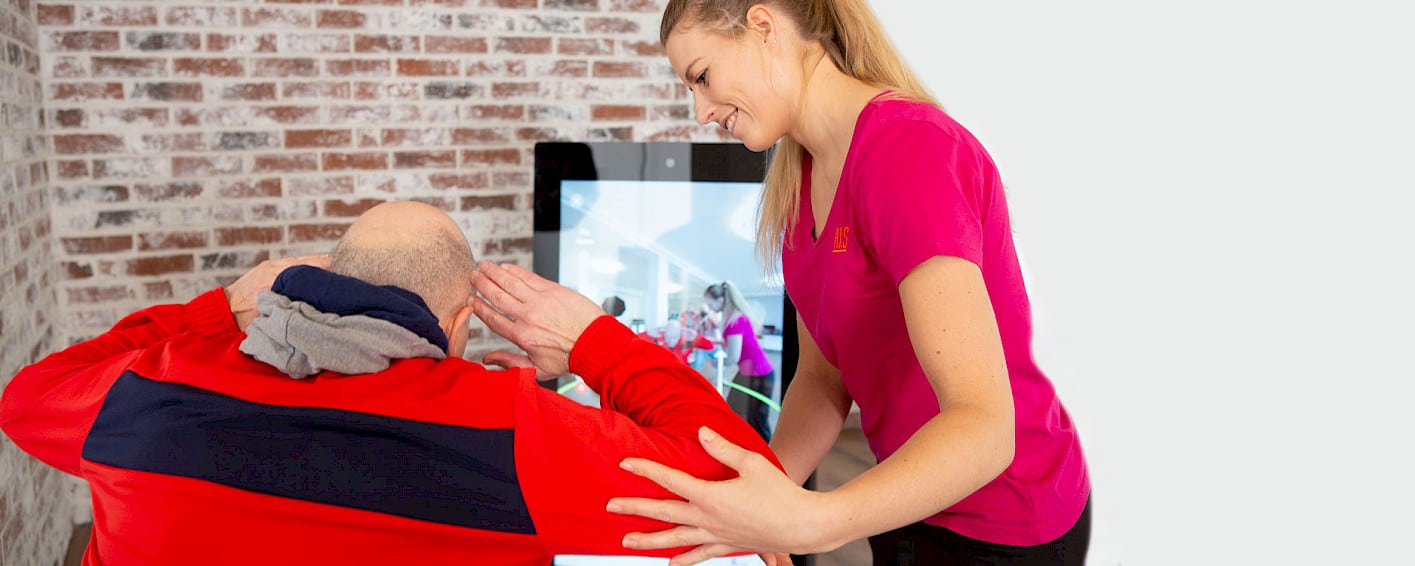
Digital training as an extension of the self-pay area
To expand the self-pay area in the area of exercise therapy, Heike Schaible chose Pixformance's digital training concept.
"Medicine – and of course the needs of patients as well as the demands on therapists – has evolved. So you naturally keep up, develop further, and look at what's new, what's different."
That's how a second self-pay area came about in a third location not far from the practice and the Wirkraum: the "Bewegungsraum" (movement room). Four Pixformance training stations were set up there in an 80 m² space.
"We often hear from our patients that they don't feel comfortable in a conventional gym. So I think this is a great way to support people in staying active."
Choosing Pixformance – from personal conviction
She was already familiar with Pixformance through her membership in the women's fitness chain Mrs.Sporty, which was co-founded by Pixformance owner Valerie Bures-Bönström. With over 200,000 users per year, the Pixformance concept has been in use there since 2013 across several European countries.
"I trained with Pixformance and I just loved it. The functional training immediately made sense to me. Then I thought that this could actually be a great complement to therapy for our clients. We often hear from patients that they don't feel comfortable in a conventional gym. So I find this a wonderful way to support people in staying active."
Many patients find this type of training easy to access, which also increases understanding of the self-pay concept.
Relieving staff pressure as a central goal
The concept of virtually supervised training and the associated relief for her own staff was another key reason for Heike Schaible's purchase decision.
"Especially when I think about the shortage of skilled workers: so many colleagues are completely burned out."
"Above all, I want to accommodate my staff and offer them simpler and more varied work. Thanks to the digital concept, my staff are significantly relieved when supervising patients at the Pixformance stations."
The training instructions from the virtual personal trainer and the real-time corrections also make it possible to supervise multiple patients at the same time – without requiring much additional supervision effort.
"The second self-pay area, the movement room, is thus another step toward better compensation and a more pleasant working day."
Most patients are immediately enthusiastic about the Pixformance stations and think they're great – further proof that moving toward digital exercise therapy was the right decision.