
Back to fit in life again
Patient activation using digital therapy devices at Niederrhein Clinic, Korschenbroich, Germany
"After occasional initial skepticism, our patients are all thoroughly enthusiastic. So we acquired three Pixformance stations. The devices are versatile, easy to use, and simply fun!"
— Christoph Schneider, Head of Therapy, Niederrhein Clinic

Christoph Schneider
Head of Therapy, Niederrhein Clinic
Clinic Profile
Location
Korschenbroich, North Rhine-Westphalia, Germany
Founded
1997
Specialization
Rehabilitation: oncology, orthopedics, neurology
Patient Capacity
240 beds
More Info
www.niederrhein-klinik.deFrom passive to active patient – with digital support
The rehab clinic at the Lower Rhine near Mönchengladbach, with over 20 years of history, focuses on local rehabilitation. Patients arrive directly from acute hospitals – after recovering from a serious illness or surgery. The goal of rehabilitation is clear: to get patients physically and mentally fit again so they can participate in all aspects of life.
In search of a way to convey to patients that they need to become independently active, Head of Therapy Christoph Schneider and his team chose Pixformance's digital therapy devices.
"We wanted to move beyond the approach of 'the therapist does something with me' to 'you have to take your destiny into your own hands.' The individual training offering with Pixformance is ideal for this, since group therapy is otherwise too easy for some and too hard for others. This way, everyone gets completely individual training."
Initially, Schneider and his team were uncertain whether patients would accept and embrace the new computer-supported offering. To find out, they decided to start with a 6-month trial of the devices.
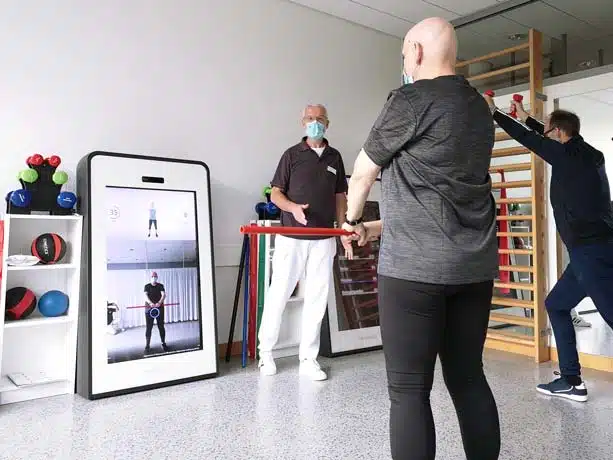
For all age groups and a wide range of health conditions
The modern therapy devices are used across all three departments of the Niederrhein Clinic – primarily in oncology. There, patients who have overcome conditions such as gastric, intestinal, lung, or breast cancer and can already move independently. Many still have limitations in endurance and strength, where digital training with targeted movement activation connects and supports.
Sometimes training is also used in orthopedics, for example after spinal surgery or with artificial joints. Training with Pixformance is now firmly integrated into patients' therapy plans.
"Patients are glad to be able to be active again themselves. They participate with full motivation and are constantly trying to improve. Such enthusiasm is rarely mustered for treatment on a therapy table."
— Christoph Schneider
The 200+ functional exercises for independent training are versatile and range from strength and endurance to balance and stability. Exercises with balls, dumbbells, resistance bands, or in a wheelchair are also possible – all under the watchful eye of the camera, which detects and notes inaccuracies in execution. After each exercise, the patient receives brief feedback on the quality of execution and what to focus on next time.
Reminding patients of their everyday life
To make rehabilitation as comfortable as possible for patients, the clinic – part of the St. Augustinus Group – considers it important that patients can preserve a piece of home during their stay. This is achieved through local rehabilitation so that relatives can visit, but also through the training itself.
"Independent training reminds them of the gym and thus of their own normal everyday life. And that is good for patients, especially considering how serious an illness some of them have been through. They are very grateful for it."
— Christoph Schneider
Personalized training options with minimal staffing effort
In addition to benefits for patients, therapists can also benefit from the digital therapy devices. Schneider emphasizes above all the simple and quick induction.
"The devices are uncomplicated and I can induct three patients simultaneously. After a brief introduction by trained therapists and sports instructors, even our oldest patients train with them without difficulty. It works great and saves us a lot of time. So we can offer personalized accompanied training for everyone with minimal staffing effort."
A contact person is always nearby for questions or adjustments, but therapists don't need to be present for every training session.
"That is a significant relief for us as therapists."
"With the QR code cards, training can proceed in a hygienically safe manner, and the devices are also quickly disinfected."
Patient care beyond the clinic stay
Alongside the rehabilitation offering, a sports program for outpatient therapy patients is also integrated at the rehab clinic. In the future, it is planned to use Pixformance therapy devices here as well, to also care for patients beyond rehab. Using the Pixformance web app, which enables supervised training beyond on-site therapy, is also a future goal.
"It is definitely in our interest to accompany our patients beyond their clinic stay. The web app will certainly play a role there."
— Christoph Schneider