
Waiting times in physiotherapy: How practices can make better use of existing capacity
Long lead times cannot be solved by simply working faster. We show you where waiting times arise and which organisational and digital approaches can create additional capacity.
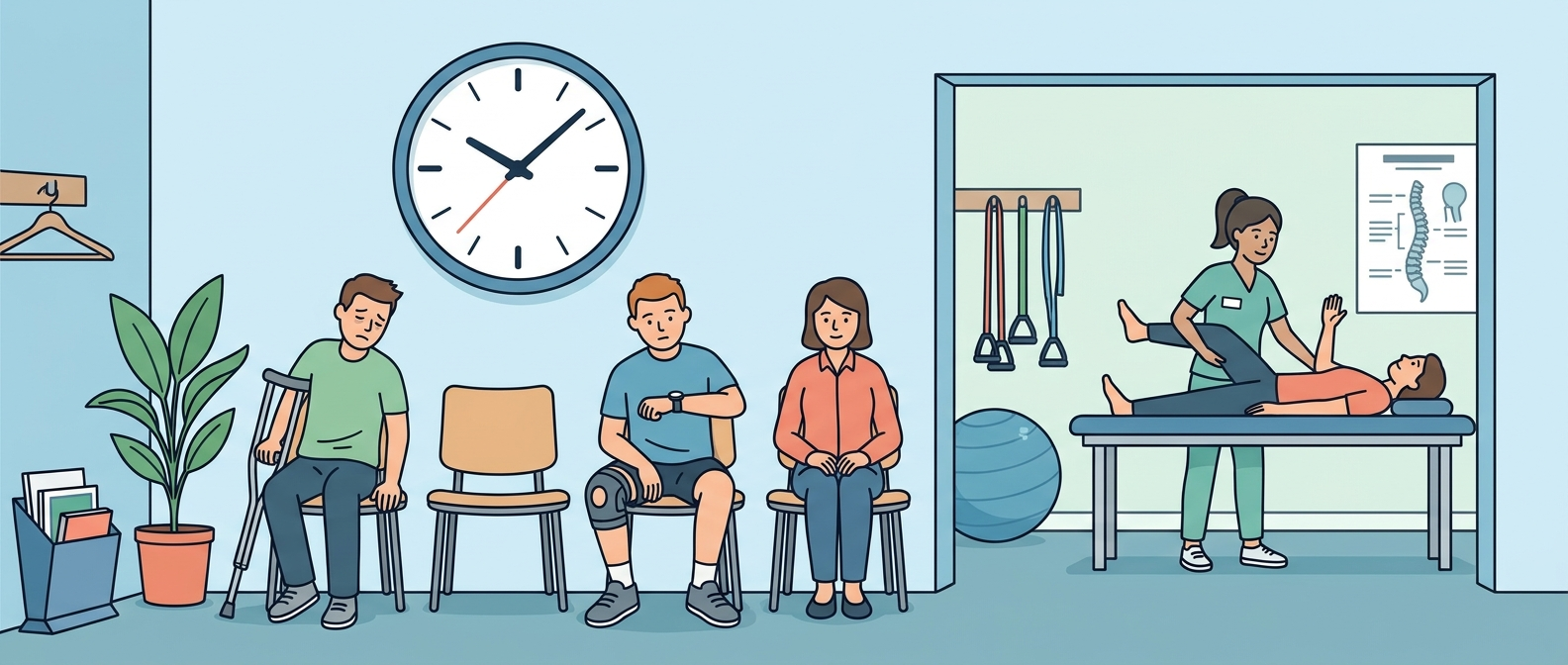
A full appointment diary sounds like a good sign at first. For many physiotherapy practices, however, it also means that new patients wait weeks for an appointment, short-notice cancellations are hard to absorb, and even minor delays throw the day's schedule into disarray.
Reducing waiting times therefore does not mean carrying out treatments faster. What matters far more is understanding where capacity is being lost – and which processes can be changed without losing sight of therapeutic quality.
Not all waiting time is the same
Before you change anything in the appointment schedule, it is worth drawing a distinction. In everyday practice, the term "waiting time" covers very different problems:
- Waiting time in the waiting room: The appointment has been booked but starts late. Causes may include tightly scheduled appointments, documentation or organisational delays between two treatments.
- Lead time until the first appointment: Several days or weeks pass between the enquiry and the first treatment appointment. Here the focus is primarily on the available treatment capacity.
- Waiting time within a course of treatment: Necessary follow-up appointments cannot take place at the desired intervals because suitable slots are not available.
Each of these situations calls for different solutions. A more generous appointment grid can reduce delays, for example, but it does not automatically create additional slots for new patients.
That is why it pays to look at punctuality and available capacity separately.
Start by reviewing existing processes
Not every longer waiting time automatically means that additional staff are needed. It is often worth taking a close look at existing processes first.
This includes, for example:
- realistic appointment durations including the necessary changeover and documentation time
- deliberately scheduled buffers
- clear rules for short-notice cancellations and free slots
- a well-maintained waiting list
- fixed time windows for initial appointments or more complex assessments
- sensibly organised use of rooms and equipment
This is not about squeezing as many appointments as possible into a working day. A good appointment grid should instead reflect how long different treatments actually take in everyday practice.
One simple option is to record, over a limited period, when appointments actually start and finish. This makes it visible whether certain types of treatment, rooms or times of day regularly lead to delays.
Buffer times can also be useful. How many of them are needed and where they should sit in the daily routine, however, depends on each practice's individual processes.
When better planning is no longer enough
Appointment planning can distribute existing capacity more effectively. But it does not create unlimited new therapist time.
When utilisation is high in particular, a further question arises: which parts of the therapy and training process require direct supervision by a therapist – and which can be organised differently?
Assessment, therapy planning, complex adjustments and therapeutic decisions naturally remain the therapist's responsibility.
With recurring training elements, the situation may look different. Exercises that are already familiar, standardised movement sequences or defined training programmes can, depending on the patient and the therapy concept, be partly carried out more independently.
This creates the opportunity to structure therapy and training processes differently without giving up professional control.
Digital exercise therapy as support in the training process
Digital training systems can provide support with these recurring training elements.
The Pixformance Station combines digital exercise guidance, immediate feedback on movement execution and automated training documentation. The therapist defines the training plan and decides on exercise selection, load and any necessary adjustments.
During the session, a virtual trainer demonstrates the exercises. An integrated camera captures the movement execution and gives the patient immediate visual and written feedback.
This allows defined training content to be carried out in a structured way, while the therapist remains responsible for professional control and individual support.
Digital exercise therapy therefore does not replace physiotherapy treatment. But it can provide support where recurring training tasks tie up therapist time in everyday practice.
Reducing waiting times also means rethinking capacity
For practices with high utilisation, it is therefore not always enough to optimise the diary alone.
The question of how existing therapist time is used is just as decisive. If recurring training processes can be sensibly structured or digitally supported, new options open up for organising the working day.
That might mean, for example:
- clearly distinguishing training times from individual treatments
- gradually introducing suitable patients to more independent training
- recording training plans in a binding format
- capturing training data automatically
- deploying therapeutic supervision specifically where it is genuinely required
Which of these makes sense always depends on the patient group, the indication, the practice structure and the therapeutic concept.
Which metrics help with planning
Whether organisational changes actually work is best assessed using a small number of regularly collected metrics.
These might include, for example:
- average lead time until the first appointment
- actual treatment start times compared with the schedule
- short-notice cancellations and missed appointments
- utilisation of individual times of day
- use of scheduled buffer times
- available training and treatment capacity
What matters here is less the largest possible volume of data than consistent observation over a longer period.
If buffers remain permanently unused, for instance, the appointment grid can potentially be adjusted. If they are regularly used up in full, on the other hand, it is worth taking a closer look at the planned cycle times and processes.
More capacity despite the skills shortage
The debate about waiting times can hardly be separated from the current staffing situation in physiotherapy.
Creating new positions is only a solution if suitable specialists are available. That is why it is becoming increasingly relevant for many organisations to consider how existing therapist time can be used more purposefully.
Our Therapy Efficiency Report 2026 also addresses this question. It combines current figures on the skills shortage with concrete approaches for physiotherapy practices, rehabilitation centres and clinics, and shows what role digitally supported training processes can play.
Download the Therapy Efficiency Report 2026 now
Conclusion: Don't treat faster, organise better
Waiting times do not arise in a single place. Appointment planning, cancellations, available rooms, therapist time and the organisation of training processes all interlock.
The first step should therefore always be to make your own processes visible. Where do delays regularly occur? Which appointments are particularly hard to plan? Where is treatment capacity genuinely lacking?
When the available therapist time becomes the limiting factor, new training and supervision concepts can also play a role.
The aim here is not to squeeze more patients into the same period of time. It is about organising existing capacity so that therapeutic expertise is deployed where it is actually needed.
Frequently asked questions
How much buffer time should an appointment grid in physiotherapy include?
There is no universally valid figure, because cycle times, routes between rooms and types of treatment vary considerably. A sensible approach is to measure real start and finish times over two to three weeks first and set the buffer accordingly. As a rule of thumb: several short blocks spread across the day are better than one large block at the end of the day, which only pushes delays further back.
Do practices lose treatment quality if they move training elements into groups?
Not necessarily. What matters is whether the quality of execution remains monitored and whether the indication requires a one-to-one setting. Assessment-dependent manual techniques and early post-operative phases belong in individual treatment. Guided strengthening and stabilisation training, by contrast, can be carried out in supervised groups or open training windows, provided that programmes are documented and feedback on movement execution is ensured.
How does digitally guided training help to reduce waiting times?
Digitally guided systems decouple training elements from one-to-one supervision. Up to four people can train at the same time on a Pixformance Station; execution is fed back in real time via joint point tracking and documented automatically. This creates slots that one member of staff can supervise while individual treatments run in parallel. That increases capacity without tightening the cycle of individual appointments.
Which metrics show whether the measures are working?
Four figures are enough to get started: the average start delay per room and time of day, the lead time until the first appointment, the no-show and short-notice cancellation rate in lost slots per week, and the actual use of buffer blocks. Collect the same values before and after the change over several weeks, otherwise seasonal fluctuations cannot be separated from genuine effects.
- reduce waiting times physiotherapy
- appointment scheduling physiotherapy practice
- practice buffer times
- group sessions physiotherapy
- rehab practice organisation
Read more

Skills shortage in physiotherapy: What the Therapy Efficiency Report 2026 reveals
Skills shortages, rising demand and limited capacity are presenting physiotherapy practices, rehabilitation centres and clinics with new challenges. Our Therapy Efficiency Report 2026 sets out current developments and approaches for making better use of the resources you already have.
2 min read